Beer Manufacture Simulator Game Details
Title: Beer Manufacture Simulator
Genre: Casual, Indie, Simulation
Developer: Games Incubator
Publisher: Games Incubator, PlayWay S.A.
Release Date: 5 March 2026
Store: Steam
Game Releasers: P2P
About Beer Manufacture Simulator Game
**From tiny mash tun to global empire, brew your destiny in Beer Manufacture Simulator, launching March 5th, 2026!**
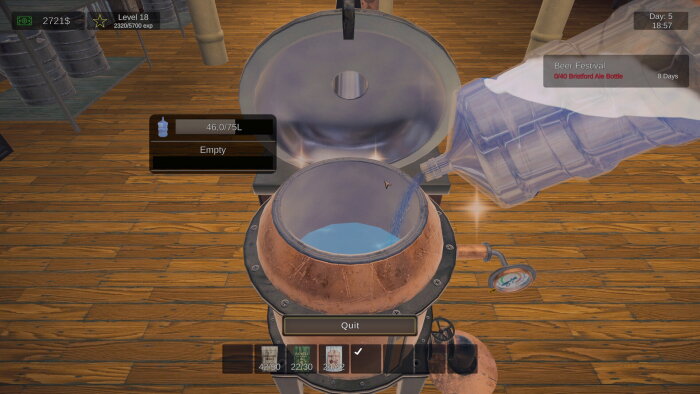
The burgeoning field of management and simulation gaming has a particularly rich vein when it comes to industries that involve tangible production, meticulous processes, and the satisfaction of seeing a raw material transformed into a desired final product. Within this niche, the upcoming Beer Manufacture Simulator promises an immersive, detailed, and ultimately rewarding journey, inviting players to step into the surprisingly complex shoes of a brewmaster. This isn't merely about clicking a button to produce a beverage; it's about mastering the ancient art and modern science of brewing, scaling those meticulous small-batch techniques into the roar of an industrial complex, and establishing a genuine brand identity in a competitive marketplace. The core appeal lies in the deep simulation mechanics that promise to mirror the real-world challenges and triumphs inherent in crafting quality beer, demanding both creativity in recipe formulation and sharp business acumen in logistics and distribution.
The initial phase of the game is deliberately grounded, forcing the novice player to appreciate the foundational steps that define all great beer. Players will begin perhaps in a humble shed or a small, converted garage, equipped with rudimentary mash tuns and basic fermentation vessels. Success here hinges entirely on understanding the four fundamental ingredients—water, malt, hops, and yeast—and how their quality and preparation dictate the potential of the final brew. Mashing, the process of steeping crushed grains in hot water to convert starches into fermentable sugars, will require precise temperature control; errors here result in thin, lifeless wort. Following the mash, the boil introduces hops for bitterness, flavor, and aroma, a stage where timing is critical to balancing these sensory contributions. The subsequent cooling and pitching of yeast mark the transition from chemistry experiment to biological process, demanding sterile conditions to prevent off-flavors introduced by rogue bacteria. This early stage acts as a crucial tutorial, emphasizing that grandeur in manufacturing is impossible without mastery at the most fundamental level.
As the player successfully navigates these initial batches, achieving desirable consistency and perhaps securing a small local following, the path toward expansion opens up. The narrative trajectory shifts from hobbyist to entrepreneur. The modest workshop must evolve, necessitating investment in larger, more efficient equipment. Moving from small, single-vessel systems to dedicated brewing houses with separate lauter tuns, kettles, and dedicated fermentation tanks introduces the first layers of industrial complexity. Resource management becomes paramount: securing reliable supplies of high-quality specialty malts, sourcing specific hop varietals harvested at peak freshness, and ensuring the consistent quality of brewing water, perhaps even investing in water treatment facilities to mimic famous brewing water profiles like those found in Pilsen or Burton-on-Trent. Each upgrade brings increased capacity but also increased risk; a failed large batch is a far more significant setback than a small homebrew mishap.
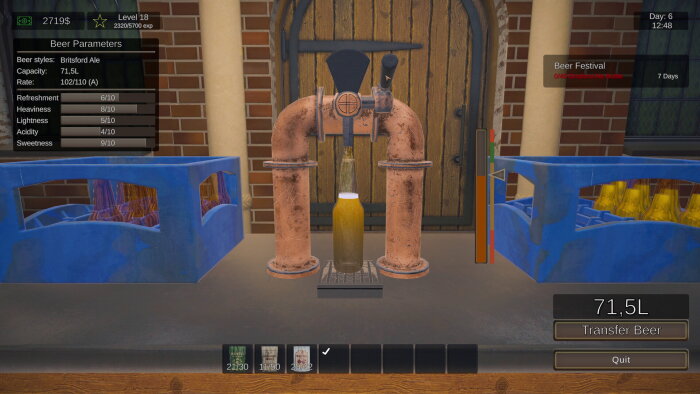
The heart of the simulation’s depth resides within the recipe creation engine. Beer Manufacture Simulator moves well beyond simple parameter sliders. Players are encouraged to treat recipes as intricate chemical and flavor equations. The selection of base malts establishes the body and color, while specialty grains contribute nuanced notes—caramel sweetness, chocolate bitterness, or dry toastiness. Hops are governed by variables like Alpha Acid content (for bitterness) and volatile oils (for aroma), demanding strategic dry-hopping schedules versus bittering additions early in the boil. Furthermore, the choice of yeast strain is not merely about fermentation efficiency; different yeasts produce distinct ester and phenol profiles that define the character of traditional styles like Belgian ales or German lagers. Experimentation here involves charting flavor matrices, tracking customer feedback against objective laboratory readings of gravity, color, and international bitterness units, striving to hit specific targets or, more excitingly, to deliberately fracture them to invent something entirely new.
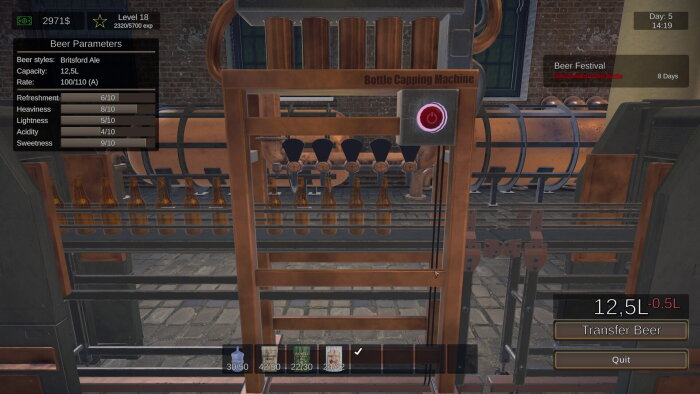
Scaling production introduces the complexities of logistics and automation, transforming the intimate art of the brewmaster into the rigorous discipline of the factory manager. As demand grows—perhaps spurred by success at local farmer's markets or positive reviews from early influencers—the need for speed and consistency outweighs personalized attention to every vessel. Players will invest in automated temperature controllers, automated grain mills, and eventually, fully integrated Clean-In-Place (CIP) systems to reduce downtime and ensure sanitation across multiple simultaneous brews. The pipeline extends beyond fermentation; packaging becomes its own mini-game. Will the focus be on high-volume canning for mass market appeal, or smaller, premium bottling runs that preserve delicate flavors but require significant quality control checks for carbonation levels and potential oxidation? Efficiently managing inventory—ensuring fermenters are cycled correctly to meet rising ingredient orders without running dry—becomes a constant balancing act against cash flow.
The competitive landscape dictated by the game world adds a layer of strategic rivalry. The simulated market is populated by established, perhaps complacent, industrial giants and a variety of niche craft competitors. Success is not guaranteed purely by producing good beer; it depends on market positioning. A player might choose to dominate the high-volume, low-margin light lager segment, requiring ruthlessly optimized production lines and distribution networks. Alternatively, they might focus on the ultra-premium, limited-edition market, where a high price point can sustain smaller, slower production cycles focused entirely on rare ingredients or experimental aging techniques, perhaps involving custom-built barrel warehouses for sour beers or barrel-aged stouts that require years of patient maturation before yielding significant profit.
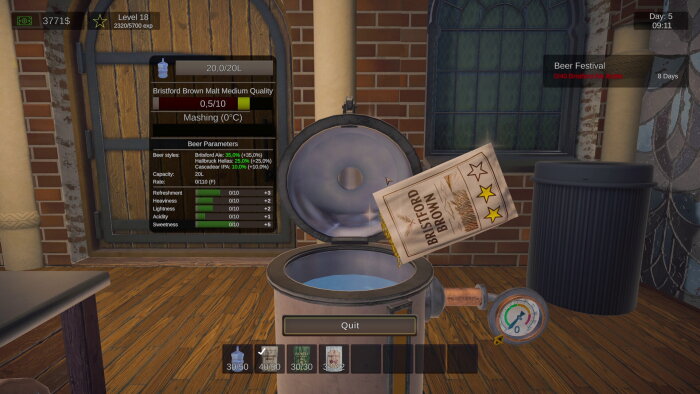
Crucially, the game integrates a narrative element that rewards the player's dedication to their craft, even amidst the industrial scale. The ability to step back from the management dashboard and observe the physical manifestation of the brewery—watching automated arms move pallets, monitoring the flow of wort through copper piping, or perhaps walking through the barrel aging cellar—provides a satisfying sensory reward for complex decisions made elsewhere. The ultimate indulgence, referenced in the game's description, is the rare opportunity to sample the final product, a moment of truth where the simulated flavor profile is presented, reflecting the triumphs and failures of resource allocation, process timing, and recipe formulation. This feedback loop ensures that the simulation remains grounded in the tactile pleasure of brewing, even when running a massive enterprise.
In essence, Beer Manufacture Simulator aims to capture the entire ecosystem surrounding modern brewing. It synthesizes management simulation, detailed process engineering, creative experimentation, and supply chain logistics into a single cohesive experience. From painstakingly sourcing the right strain of saison yeast for a summer release to negotiating bulk contracts for stainless steel tanks, the complexity scales organically with the player’s ambition. Set for release in early 2026, developed by the team at Games Incubator and published in partnership with PlayWay S.A., this title positions itself not just as a casual simulation, but as a deep dive into the entrepreneurial spirit required to build a successful, flavorful, and enduring beer empire from the ground up, offering a comprehensive look at how passion evolves into industrial might.
Beer Manufacture Simulator Key Features
- Become the ultimate Brewmaster, starting small and building a massive beer empire!
- Master every intricate step of the brewing process, from mashing grains to bottling!
- Unleash creativity by experimenting with diverse ingredients and crafting unique signature brews!
- Expand your operation from a humble workshop to a fully automated, globe-spanning factory!
- Discover and perfect recipes spanning real-world styles like IPAs, Stouts, and Lagers!
- Manage resources, optimize production, and watch your passion turn into profit!
Beer Manufacture Simulator Gameplay
Download Links for Beer Manufacture Simulator
Download Beer.Manufacture.Simulator.Build.22848953
Mega
Beer.Manufacture.Simulator.Build.22848953.zip
1fichier
Beer.Manufacture.Simulator.Build.22848953.zip
Pixeldrain
Beer.Manufacture.Simulator.Build.22848953.zip
Mediafire
Beer.Manufacture.Simulator.Build.22848953.zip
Gofile
Beer.Manufacture.Simulator.Build.22848953.zip
Ranoz
Beer.Manufacture.Simulator.Build.22848953.zip
Bowfile
Beer.Manufacture.Simulator.Build.22848953.zip
Frdl
Beer.Manufacture.Simulator.Build.22848953.zip
Wdfiles
Beer.Manufacture.Simulator.Build.22848953.zip
Mixdrop
Beer.Manufacture.Simulator.Build.22848953.zip
Chomikuj
Beer.Manufacture.Simulator.Build.22848953.zip
Vikingfile
Beer.Manufacture.Simulator.Build.22848953.zip
Down mdiaload
Beer.Manufacture.Simulator.Build.22848953.zip
Hexload
Beer.Manufacture.Simulator.Build.22848953.zip
1cloudfile
Beer.Manufacture.Simulator.Build.22848953.zip
Usersdrive
Beer.Manufacture.Simulator.Build.22848953.zip
Megaup
Beer.Manufacture.Simulator.Build.22848953.zip
Clicknupload
Beer.Manufacture.Simulator.Build.22848953.zip
Dailyuploads
Beer.Manufacture.Simulator.Build.22848953.zip
Rapidgator
Beer.Manufacture.Simulator.Build.22848953.zip
System Requirements for Beer Manufacture Simulator
To run the Beer Manufacture Simulator, the **minimum requirements** specify a system running Windows 10, equipped with at least an Intel Core i5-9400F or AMD Ryzen 5 3600 processor, paired with 16 GB of RAM, and an NVIDIA GeForce GTX 1660 or AMD Radeon RX 5600 XT graphics card, all necessitating DirectX Version 12 support and 8 GB of free storage space, with an SSD strongly recommended for installation. For the **recommended experience**, the game still requires Windows 10 and 16 GB of RAM, but suggests a faster Intel Core i5 clocked at 3.4 GHz or an Intel Arc 580/NVIDIA GeForce GTX 2060 for graphics, with the required storage increasing slightly to 12 GB, while still maintaining the recommendation for an SSD installation.
Minimum:- OS: Windows 10
- Processor: Intel Core i5-9400F lub AMD Ryzen 5 3600
- Memory: 16 GB RAM
- Graphics: NVIDIA GeForce GTX 1660 lub AMD Radeon RX 5600 XT
- DirectX: Version 12
- Storage: 8 GB available space
- Additional Notes: Recommend installation on an SSD drive
- OS: Windows 10
- Processor: Intel Core i5 3.4 GHz
- Memory: 16 GB RAM
- Graphics: Intel Arc 580, GTX 2060
- DirectX: Version 12
- Storage: 12 GB available space
- Additional Notes: Recommend installation on an SSD drive
How to Download Beer Manufacture Simulator PC Game
1. Extract Release
2. Launch The Game
3. Play!