Conductor: Eternal Service Game Details
Title: Conductor: Eternal Service
Genre: Indie, Simulation
Developer: Beshbarmak games
Publisher: Beshbarmak games
Release Date: 21 March 2026
Store: Steam
Game Releasers: P2P
About Conductor: Eternal Service Game
**Punch your ticket to terror in *Conductor: Eternal Service*, the atmospheric horror sim where mundane train duties collide with demonic possession.**
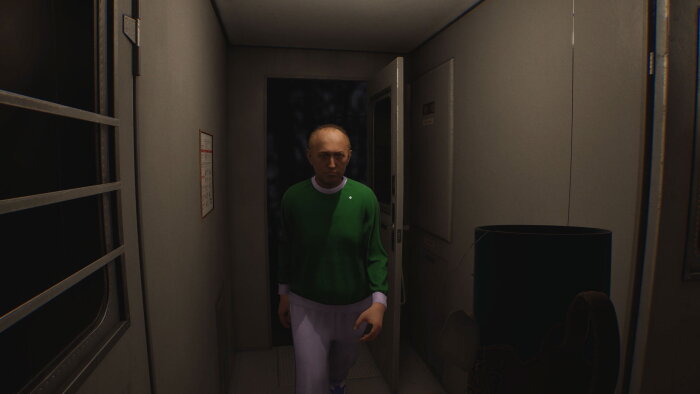
The notion of an ordinary night shift, a predictable rhythm of duty and routine, is fundamentally shattered by the premise of Conductor: Eternal Service, an experience that meticulously layers the mundane aspects of a train conductor’s responsibilities over a foundation of creeping, atmospheric horror. This simulation plunges the player into the confined, often claustrophobic world of a moving carriage, where the expected tasks of monitoring passengers, ensuring cleanliness, and maximizing sales become increasingly perilous as the supernatural encroaches upon the everyday. The initial immersion is deceptively placid, focused entirely on the rigorous adherence to protocol, establishing a baseline of normalcy against which the ensuing terror can be measured. The player must first master the mechanical aspects of the job, proving their competence in the face of bureaucratic scrutiny before the true, unholy challenges begin to manifest.
The core gameplay loop orbits around the strict execution of the conductor’s working routine, a series of interconnected tasks designed to simulate the relentless pressures of customer service and operational maintenance aboard a passenger train. Boarding procedures demand vigilance; every ticket must be verified, and any deviation from acceptable passenger conduct must be swiftly addressed to avoid costly penalties that gnaw at the conductor’s meager earnings. This necessitates constant movement, scanning faces, and interacting with the revolving door of humanity that passes through the carriage. Following the initial rush of boarding, the focus shifts to maintaining an impeccable standard of hygiene and order. Trash accumulates rapidly in the narrow aisles, floors require mopping to ensure a non-slip surface, and the bedding, essential for long-haul comfort, must be meticulously changed and folded upon request or specified intervals. These tasks are not optional; they are foundational checks that, if neglected, create visible markers of failure that impact the end-of-shift assessment.
Complementing the maintenance duties is the critical element of commerce and plan fulfillment, a constant pressure cooker demanding profitable interaction with the captive audience. The conductor is tasked with hawking essential travel provisions—hot tea brewed in the samovar, various snacks that sustain weary travelers, and perhaps a few cheap souvenirs designed purely for tourist appeal. Meeting the predetermined sales targets is crucial not just for maximizing personal profit but for avoiding disciplinary action related to underperformance. The equipment itself plays a role here; maintaining the samovar’s temperature for constant readiness—a necessity for both tea and the instant noodles frequently requested by late-night travelers—is a delicate balancing act between energy conservation and customer satisfaction. Every successful transaction contributes incrementally to the conductor's budget, which can then be reinvested into crucial upgrades.

These upgrades represent the tantalizing promise of progression within the simulation, allowing the player to mitigate future difficulties or enhance profit margins. Expanding the available range of goods directly translates to higher potential revenue per passenger interaction. Investing in better equipment can streamline maintenance tasks, perhaps leading to a more efficient mopping system or a self-regulating temperature gauge for the samovar. These improvements offer a temporary sense of control, a buffer against the inevitable penalties that arise from minor infractions—a dusty corner, an expired ticket, or a slightly lukewarm cup of tea all chip away at the conductor’s financial standing and psychological state. The game cleverly ties financial stress directly into the horror element; the more stressed and penalized the conductor, the more susceptible they may become to overlooking the subtle signs of the truly terrifying events unfolding around them.
However, the carefully constructed world of routine and commerce serves merely as the stage dressing for the central conflict: the infiltration of pure, malevolent evil. Once the superficial duties are established, the true nature of the night shift emerges. Among the weary travelers, the students, and the working-class passengers, lurk those who have been fundamentally corrupted, possessed by demonic entities. Recognizing these individuals is the first, and perhaps most frightening, layer of the supernatural challenge. Possession manifests not through obvious guttural screaming, but through subtle anomalies in behavior, unnatural stillness, distorted facial micro-expressions, or perhaps an uncharacteristic interaction that violates the established social contracts of public transport.
The identification process is a high-stakes guessing game reliant on keen observation and perhaps intuition gained through painful past errors. Once a potential host is identified, the player must delve deeper, attempting to ascertain which specific entity holds sway over the unfortunate individual. Different demons, it is implied, respond to different countermeasures, turning the conductor’s inventory, which normally consists of tea bags and cheap trinkets, into a hidden arsenal of spiritual defense. This involves locating and selecting the correct holy icon from a hidden cache or perhaps an increasingly precarious personal bag. The tension resides in the time limit—the train hurtles towards the next station, and time spent agonizing over the wrong talisman is time lost, risking the demonic entity asserting full control or, worse, attacking preemptively.

The consequences of error are severe, far exceeding the mere loss of premium service fees or a minor reprimand from a central dispatcher. A wrongly applied icon, or hesitating too long while a demon consolidates its hold, can result in swift, brutal reprisals that drastically alter the game state, potentially leading to immediate failure or permanent handicaps for the conductor’s ongoing journey. Each station stop represents a resetting of external variables and an opportunity for the possessed to disembark, or for new, equally tainted passengers to board. The journey transforms from a linear route into a gauntlet, where the perceived safety of the moving train is constantly undermined by the proximity of hidden evil, making the simple act of walking down the aisle feel like traversing hostile territory.
Ultimately, Conductor: Eternal Service strips away the romanticism often associated with train travel and replaces it with a suffocating sense of obligation fused with existential dread. The player is trapped between the mundane demands of the employer—sell more snacks, keep the floor clean—and the absolute, terrifying necessity of protecting their own reality from supernatural contamination. Can one truly focus on calculating the correct change for a packet of biscuits while simultaneously wrestling with the spiritual obligation to perform an emergency exorcism on the passenger sitting directly across the aisle? The game posits that the answer lies in a fragile, nearly impossible synthesis of these competing roles, forcing the conductor to become more than just a ticket-puncher and cleaner; they must become an unwilling, poorly equipped guardian against forces that ride discreetly in coach class, waiting for the perfect moment to claim the entire carriage as their own. The promise of the 2026 release date hints at a fully realized vision where the relentless pressure of routine breaks down into pure, unadulterated confrontation with the infernal, all while the samovar continues to hiss for tea.
Conductor: Eternal Service Key Features
- Dive into the chilling routine of a train conductor!
- Face demonic possessions among your unsuspecting passengers!
- Perform mundane tasks like ticket checks, cleaning, and sales.
- Struggle to meet sales targets while sanity slips away!
- Upgrade your service to maximize profits and survive!
- Identify possessed passengers and choose the correct holy icon to banish evil!
- Master the balance between everyday service and supernatural horror!
- Every station stop brings a fresh wave of potential terror!

Conductor: Eternal Service Gameplay
Download Links for Conductor: Eternal Service
Download Conductor.Eternal.Service-Repack
Mega
Conductor.Eternal.Service-Repack.iso
1fichier
Conductor.Eternal.Service-Repack.iso
Pixeldrain
Conductor.Eternal.Service-Repack.iso
Gofile
Conductor.Eternal.Service-Repack.iso
Ranoz
Conductor.Eternal.Service-Repack.iso
Drop
Conductor.Eternal.Service-Repack.iso
Bowfile
Conductor.Eternal.Service-Repack.iso
Frdl
Conductor.Eternal.Service-Repack.iso
Mixdrop
Conductor.Eternal.Service-Repack.iso
Chomikuj
Conductor.Eternal.Service-Repack.iso
Vikingfile
Conductor.Eternal.Service-Repack.iso
Down mdiaload
Conductor.Eternal.Service-Repack.iso
Hexload
Conductor.Eternal.Service-Repack.iso
1cloudfile
Conductor.Eternal.Service-Repack.iso
Usersdrive
Conductor.Eternal.Service-Repack.iso
Megaup
Conductor.Eternal.Service-Repack.iso
Clicknupload
Conductor.Eternal.Service-Repack.iso
Rapidgator
Conductor.Eternal.Service-Repack.iso
Nitroflare
Conductor.Eternal.Service-Repack.iso
Multiup
Conductor.Eternal.Service-Repack.iso
Torrent
Pixeldrain - Gofile - Clicknupload - 1fichier
System Requirements for Conductor: Eternal Service
To run the **Eternal Service System** by Conductor, the minimum requirements specify a 64-bit operating system of Windows 10 or 11, paired with at least an Intel Core i3-10100F or AMD Ryzen 5 3500 processor, 8 GB of RAM, and a graphics card equivalent to the GeForce GTX 1050ti 4GB or AMD Radeon R7 370 4GB; 8 GB of storage space is needed, with an SSD being recommended over a standard HDD. For an optimal experience, the developers recommend upgrading to an Intel i5-10600K (4.1 GHz 6 Core) or AMD Ryzen 5 5600 (4.4 GHz 6 Core), doubling the memory to 16 GB RAM, and using a significantly more powerful GPU such as the GeForce RTX 3060 12GB (or a similar card with at least 6 GB of VRAM), while still requiring 8 GB of available storage, ideally on an SSD.
Minimum:- OS: WINDOWS® 10, 11 (64-bit)
- Processor: Intel® Core™ i3-10100F / AMD Ryzen 5 3500
- Memory: 8 GB RAM
- Graphics: GeForce® GTX 1050ti 4GB / AMD Radeon R7 370 4GB
- Storage: 8 GB available space
- Additional Notes: 8GB HDD (SSD recommended)
- OS: WINDOWS® 10, 11 (64-bit)
- Processor: Intel® i5-10600K 4.1 GHz 6 Core™ / AMD Ryzen™ 5 5600 4.4 GHz 6 Core™
- Memory: 16 GB RAM
- Graphics: GeForce® RTX 3060 12GB (or or a similar one with 6 GB VRAM+)
- Storage: 8 GB available space
- Additional Notes: 8GB SSD
How to Download Conductor: Eternal Service PC Game
1. Extract Release
2. Launch The Game
3. Play!