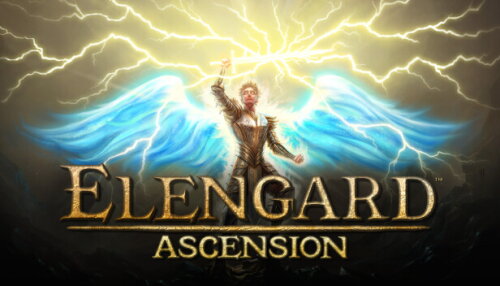
Elengard: Ascension Game Details
Title: Elengard: Ascension
Genre: Action, Adventure, RPG, Strategy
Developer: Stèphano M. M. G.
Publisher: Stèphano M. M. G.
Release Date: 19 January 2026
Store: Steam
Game Releasers: P2P
About Elengard: Ascension Game
**Rise from a shadowed existence to a demi-god in Elengard: Ascension, an epic Real-Time-with-Pause RPG blending deep classless customization, strategic combat choice, and a dark fantasy adventure inspired by *Dragon Age* and *LotR*.**
Embark on an epic odyssey into the burgeoning world of Elengard: Ascension, a fresh and ambitious medieval fantasy Role-Playing Game that masterfully weaves together the strategic depth of classic Real-Time-with-Pause mechanics with the visceral engagement of modern Action RPG elements. This is not merely another click-fest of indiscriminate button mashing, nor does it adhere to the punishing difficulty curve of the Soulslike genre; instead, Elengard: Ascension carves its own niche by demanding thoughtful engagement in every encounter, allowing players to truly shape their path from an unassuming villager to a figure of legendary power. The initial allure lies in the promise of ascension, a journey where the player’s decisions in combat, character building, and exploration directly dictate the magnitude of their growing might, pushing them towards a destiny that hints at demi-god status within this richly detailed setting. The core experience is designed to reward strategic foresight as much as quick reflexes, fostering a deeply personal connection to the character's evolution amidst a world teetering on the brink of encroaching darkness.
The combat system stands as one of the game's most defining features, offering a duality rarely seen executed with such clarity. Players have the freedom to select a combat mode that best suits their preferred playstyle or the immediate tactical demands of the situation. The traditional Automatic Mode channels the spirit of beloved CRPGs like Dragon Age: Origins and Neverwinter Nights, where tactical commands are issued, and the character executes attacks and basic maneuvers autonomously, freeing the player to focus on overall squad management, ability cooldowns, and strategic positioning—a true testament to classic isometric tactical role-playing. Conversely, the Manual Mode injects an immediate, action-oriented layer. Here, the player must actively click to initiate attacks and press designated keys to execute defensive maneuvers such as blocking or dodging. While this mode offers closer control reminiscent of Action RPGs, it remains distinctly different, emphasizing timing, resource management (like stamina), and precise execution rather than pure button mashing, ensuring that even in the action state, tactical consideration remains paramount to survival and success against increasingly formidable adversaries.
Beyond the moment-to-moment combat, the architecture of character progression in Elengard: Ascension is intentionally designed to shatter traditional rigid class structures. Central to this groundbreaking design is the massive Ability/Skill Tree, described as a sprawling nexus of potential where players face absolutely no level restrictions or mandated class restrictions when selecting new proficiencies. This unparalleled freedom means that a Warrior, for instance, is not inherently barred from learning potent magical spells or intricate priestly blessings, leading directly to the creation of truly unique, hybrid builds and complex combos that defy conventional categorization. Furthermore, the system incorporates an 'Ability Configuration' layer, particularly potent for intricate spellcasting. Players are empowered to fine-tune various parameters of their chosen abilities—adjusting power scaling, refining attack range, altering the radius of area effects, and more. This granular control allows for meticulous tuning, ensuring that every learned skill can be adapted precisely to the player's vision for their character, fostering an environment where ingenuity in build crafting is richly rewarded through synergistic effects and novel combat strategies.
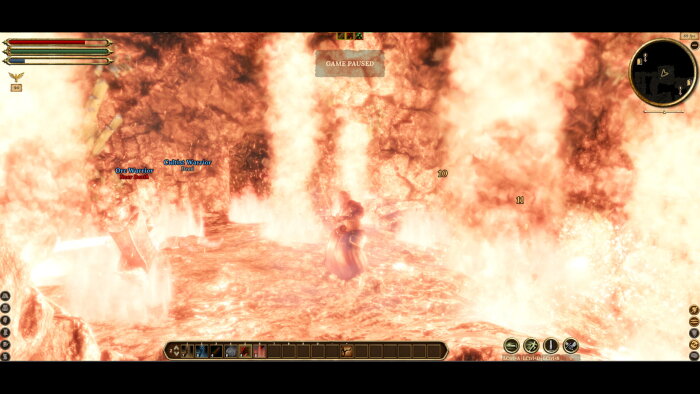
Driving the depth of player choice is the mechanic titled 'Choose how you fight,' which extends strategic decision-making far beyond simply selecting an attack spell. This system forces constant evaluation of risk versus reward in every engagement. Do you rely on blocking, a low-stamina, low-cost defense that risks severe staggered states if an enemy strike is too powerful? Or do you opt for the high-stamina cost of dodging, providing superior evasion but potentially draining resources quickly? Tactical choices permeate weapon usage as well: will you favor sweeping attacks that maximize impact against clustered foes, accepting a reduced hit chance, or meticulously focus on single-target elimination? Furthermore, weapon handling itself is a choice—do you use wide swings that prioritize impact and crowd control, or precise thrusts that carry a higher risk of a complete miss but promise greater potential damage upon connection? Even the dualistic choice of one-handed versus two-handed weapon wielding, or prioritizing attack speed over brute force, or leaning into an aggressive posture versus a defensive stance, all contribute to a strategic tapestry where no two fights need be approached identically.
The narrative framework supporting this journey is steeped in mystery and a sense of destined purpose. The player begins in idyllic simplicity, a life bordering on the mundane within a beautiful, nature-infused village. However, this peace is immediately undercut by a persistent, almost existential disquiet—a feeling of being an incomplete shadow of one's potential. This internal dissonance soon externalizes as the discovery of a potent, localized curse, one that threatens not just the player but their immediate community, branded by some as a divine retribution. Yet, the character knows they are innocent, transforming the quest for a cure into a far grander mystery of self-discovery. As the journey begins, this personal affliction intertwines chillingly with a pervasive, growing darkness corrupting the ambient world. The protagonist feels an inexplicable pull toward this corruption, a responsibility suggesting their fate is inextricably linked to the land's salvation. This initial historical context sets the stage for an epic confrontation, demanding the player simultaneously fight for survival, seek tangible power, and unearth fundamental truths about their own identity and the nature of the encroaching shadow.
Elengard: Ascension introduces an Archetype System that cleverly parallels traditional classes without enforcing their restrictive nature. Instead of locking ability selection behind an initial class choice, archetypes—inspired by the foundational D&D framework, including Warrior, Rogue, Mage, Priest, and Druid—serve more as natural affinity paths. While players retain the freedom acquired through the skill tree to learn any ability, specific, powerful abilities are intrinsically linked to certain archetypes. Engaging with and utilizing these archetype-associated skills contributes to increasing the corresponding archetype level. This level advancement is not mandatory for progression but offers supplementary bonuses, encouraging players to lean into certain thematic styles while maintaining the flexibility to diverge significantly from the archetype’s core specialization. This model successfully marries the comfort of familiar fantasy roles with the system's overarching commitment to build freedom, allowing for organic specialization rather than imposed definition.
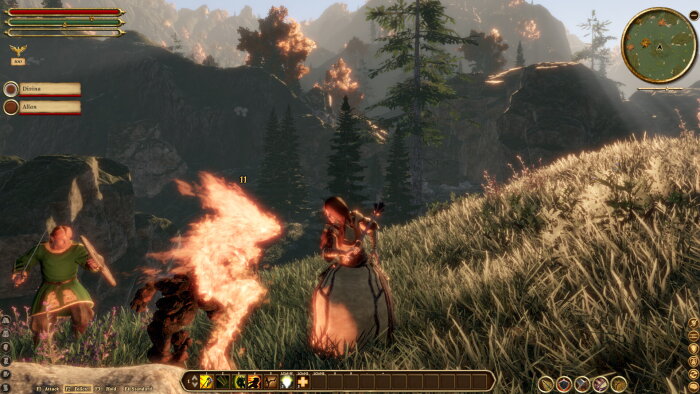
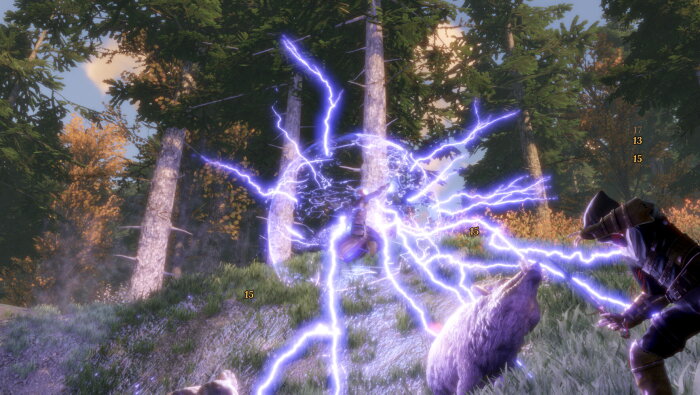
Visual presentation is deeply integrated with the underlying mechanics, ensuring that the world not only looks the part of a grand fantasy setting reminiscent of Tolkien and Dragon Age but also fluidly communicates the success or failure of the player’s inputs. The commitment to responsiveness means that animations are not merely cosmetic placeholders. If a player successfully executes a dodge maneuver in Manual Mode, the animation visibly reflects that evasive action; similarly, a successful block will be clearly animated as such. This visual feedback loop is extended to spellcasting, where visual effects are meticulously calibrated to mirror the ability's configuration. For example, an Electric Orb whose power has been significantly augmented via the configuration menu will display correspondingly intense and expansive visual discharge, reinforcing the mechanical impact and making the character's growing power tangible to the eye. Furthermore, the world itself promises a beautiful semi-open map design, emphasizing stark, dramatic contrasts between light and shadow, building an atmosphere ripe for exploration and discovery.
While the immediate developmental focus remains firmly planted in delivering a compelling, feature-rich single-player experience, the long-term vision for Elengard: Ascension includes a strong intent to expand these rich mechanics into a shared multiplayer environment sometime in the future. This foresight suggests that the complex combat dynamics and deep build customization are being engineered with scalability in mind. For the present, however, the game delivers a complete suite of essential RPG features: robust main and side quests to drive the narrative forward, comprehensive trade mechanics for buying and selling goods, detailed item crafting to supplement looted gear, and item enchanting to further augment equipment performance. Character customization allows for detailed appearance adjustments, including gender selection, and the equipment system promises meaningful visual changes, though currently limited to visible armor, clothing, and weaponry—jewelry models are slated for future inclusion. Players can look forward to engaging with multiple-choice dialogues that shape narrative branches, rounding out a comprehensive RPG package built around strategic combat and unparalleled character freedom, all leading towards that thrilling pinnacle of becoming an epic, near-mythic figure in the world of Elengard.
Elengard: Ascension Key Features
- Embark on an epic medieval fantasy adventure combining action and deep strategy!
- Master Real-Time-with-Pause combat with highly customizable Automatic or Manual attack modes!
- Unleash limitless build potential with a massive, class-restriction-free Ability/Skill Tree!
- Fine-tune every spell with Ability Configuration—control power, range, and more!
- Make critical strategic choices in every fight: block, dodge, area attack, or focus fire!
- Ascend to epic, demi-god-like power with no character level cap!
- Explore a beautiful, contrasting semi-open world inspired by LOTR and Dragon Age!
- Forge unique paths with an Archetypes System drawing inspiration from D&D classes!
- Witness visuals that dynamically react to every mechanic, from dodges to spell strength!
- Dive into a rich narrative about uncovering a dark curse and finding your true purpose!
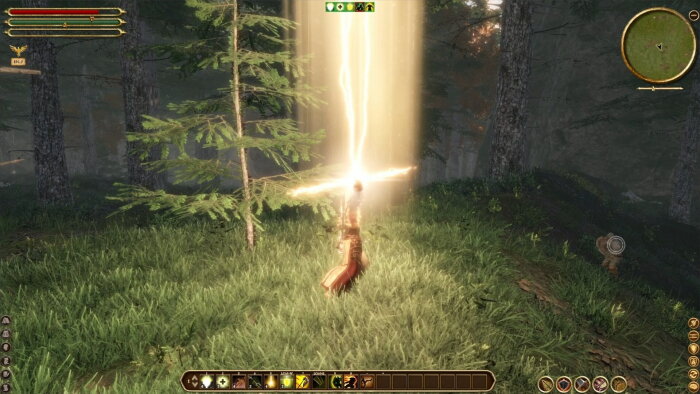
Elengard: Ascension Gameplay
Download Links for Elengard: Ascension
Download Elengard.Ascension.Build.22335209
1fichier
Elengard.Ascension.Build.22335209.zip
Gofile
Elengard.Ascension.Build.22335209.zip
Buzzheavier
Elengard.Ascension.Build.22335209.zip
System Requirements for Elengard: Ascension
To run Elengard: Ascension, the minimum system requirements necessitate a Windows 10 operating system, an AMD Ryzen 5 3400G with Radeon Vega Graphics or a comparable processor, 8 GB of RAM, and an integrated AMD Radeon(TM) RX Vega 11 Graphics solution, all while requiring 40 GB of storage space. For an optimal experience, the developers recommend upgrading to a Windows 10 environment paired with a more powerful AMD Ryzen 7 3700X processor, significantly increasing the memory requirement to 24 GB of RAM, and utilizing a dedicated graphics card such as the GeForce RTX 3060ti or an equivalent, though the necessary storage remains at 40 GB, with the added suggestion of using an SSD for improved loading times.
Minimum:- OS: Windows 10
- Processor: AMD Ryzen 5 3400G with Radeon Vega Graphics or equivalent
- Memory: 8 GB RAM
- Graphics: AMD Radeon(TM) RX Vega 11 Graphics or equivalent
- Storage: 40 GB available space
- OS: Windows 10
- Processor: AMD Ryzen 7 3700X or equivalent
- Memory: 24 GB RAM
- Graphics: GeForce RTX 3060ti or equivalent
- Storage: 40 GB available space
- Additional Notes: SSD recommended
How to Download Elengard: Ascension PC Game
1. Extract Release
2. Launch The Game
3. Play!