Kagaribi Game Details
Title: Kagaribi
Genre: Adventure, Casual, Indie
Developer: NewForeverSTUDIO
Publisher: NewForeverSTUDIO
Release Date: 26 March 2026
Store: Steam
Game Releasers: P2P
About Kagaribi Game
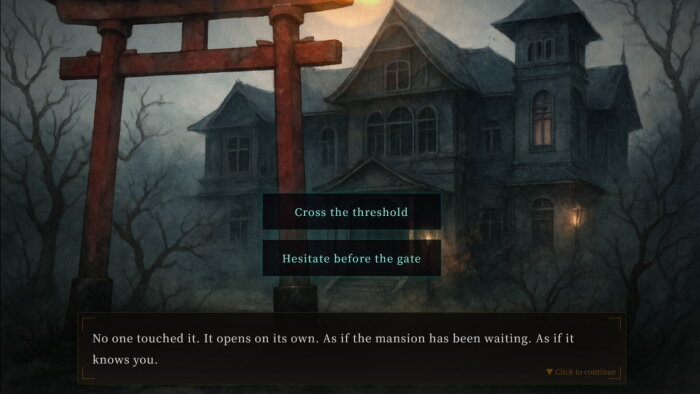
Kagaribi, a much-anticipated title emerging from the creative crucible of New Forever STUDIO, promises a deep dive into the unsettling beauty of Taisho-era psychological horror. This is not a game content with superficial scares; instead, it aims to weave a tapestry of dread through atmosphere, history, and deeply personal internal conflict. The core mystery revolves around reclaiming one's stolen identity, a fundamental loss that serves as the anchor for the player's perilous journey through a haunted mansion saturated with spectral residue. The unique auditory landscape, characterized by a fascinating juxtaposition of traditional Koto melodies against the pulsing, modern undertones of Deep House music, immediately signals that Kagaribi is charting unique sonic territory, ensuring that the player's immersion is as much auditory as it is visual and narrative.
The genesis of Kagaribi is attributed to the singular vision of the studio's CEO, a figure who identifies as a "56yo Vibe Coder." This self-designation hints at the unconventional development methodology employed, termed "Vibe Coding," which suggests an artistic process where human emotion and AI intelligence are deliberately fused to forge a surreal and dreamlike aesthetic quality. This commitment to a specific, evocative atmosphere over conventional design tropes underscores the developer's mission: to deliver authentic Japanese Gothic Horror to a global audience, asserting that genuine artistic "Soul" can indeed transcend mere technological capability. The project, scheduled for a 2026 unveiling, carries the promise of a multi-ending visual novel experience where the weight of every decision resonates with profound consequence, forcing players to confront moral ambiguities under the oppressive gaze of the mansion's inhabitants.
Central to the narrative exploration are three distinct, tragically tethered characters. First among them is Kagari, the player's avatar, a young man adrift in an abyss of forgotten history. He awakens stripped of his name and context, tethered only by the faint echo of a nostalgic voice and an overwhelming, suffocating sense of profound personal absence. The player's role is to sift through the fragmented shards of recollection, navigating choices that might illuminate the path forward, yet simultaneously warning that illumination might reveal truths far more agonizing than comfortable forgetfulness. His journey is a quest for ontological restoration, fraught with the danger that discovering "who" he was might be less desirable than remaining the blank slate he currently is.

Then there is Homura, a young woman whose existence is etched with the painful markings of past conflagrations. She arrives at the Kagaribi seeking refuge from the vivid spectral memory of the fire that claimed her grandmother—a personal trauma that has curdled into crushing guilt. Homura's fate is a direct measure of the player's moral compass; their choices act as the decisive element in whether the spectral flames consume her spirit entirely or, conversely, transform into a guiding source of transformative light. Her arc presents a critical examination of atonement versus self-destruction, forcing the audience to weigh empathy against pragmatic survival within the mansion’s oppressive historical framework.
The third, and perhaps most enigmatic figure, is Kinrei, also known as Aurelia, a spirit whose thousand-year vigil for a lost beloved has twisted her essence into a state of beautiful, yet perilous, madness. Her presence oscillates between serene, gentle gestures and terrifying displays of obsessive attachment. The player is tasked with solving the riddle of her character: is she the monstrous entity guarding the mansion, or is she a tragic heroine desperately requiring rescue from her own undying devotion? Successfully navigating her narrative path requires the player to delineate the razor-thin boundary separating profound, enduring love from consuming, destructive obsession; failure to discern this difference ensures permanent entrapment within the recursive world of Kinrei’s sorrowful memories.
The narrative structure itself begins with an abrupt, disorienting awakening within a profound and atmospheric void, immediately punctuated by the spectral presence of the Kagaribi—the signal bonfire that gives the game its title. Surrounding this elemental beacon are the three bound spirits, each personifying a different flavor of eternal regret and unresolved memory. The player is propelled forward not by maps or overt direction, but by auditory hallucinations—haunting vocals and cryptic, fragmented visions suggesting a labyrinthine connection to the past. The central thematic questions remain stark: What chain of events led to this moment of amnesia? What vital piece of self has been purposefully forgotten? And what unimaginable horror resides within the chilling concept referred to only as the "Abyss"?
Kagaribi distinguishes itself through its commitment to Atmospheric Horror. This genre preference mandates a deliberate subversion of typical horror mechanics; instead of relying on cheap jolts, the experience thrives on the slow accretion of psychological tension. This pervasive dread is meticulously crafted through the game’s technical and artistic choices, informed by the "Vibe Coding" approach. This unique development technique seeks not just to render a world but to imbue it with a specific emotional texture—a surreal, almost hallucinatory quality that blurs the lines between reality, memory, and nightmare, echoing the very disorientation experienced by the protagonist, Kagari.
The haunting soundtrack is another cornerstone of this atmosphere. It deliberately eschews conventional horror scoring, opting instead for a sophisticated fusion that marries the smooth, nostalgic textures of City Pop—a genre often associated with late 20th-century Japanese urbanity—with the grim, enveloping soundscapes of Dark Ambient music. This juxtaposition mirrors the game’s blending of the Taisho era with modern artistic sensibilities. Furthermore, the game offers significant mechanical flexibility, catering to diverse player preferences: it includes multiple distinct conclusion states dictated entirely by accumulated choices, full-screen display options to maximize immersion, a functional screenshot utility for preserving moments, and a robust system offering ten distinct save slots, acknowledging the branching complexity of its narrative pathways. In the world of Kagaribi, rebirth is a constant possibility, suggesting that the journey through oblivion is cyclical, and only through understanding the past can one hope to break the eternal watchfire’s hold.
Kagaribi Gameplay
Download Links for Kagaribi
Download Kagaribi.Build.22516710
Mega
Kagaribi.Build.22516710.zip
1fichier
Kagaribi.Build.22516710.zip
Pixeldrain
Kagaribi.Build.22516710.zip
Mediafire
Kagaribi.Build.22516710.zip
Gofile
Kagaribi.Build.22516710.zip
Ranoz
Kagaribi.Build.22516710.zip
Drop
Kagaribi.Build.22516710.zip
Bowfile
Kagaribi.Build.22516710.zip
Frdl
Kagaribi.Build.22516710.zip
Wdfiles
Kagaribi.Build.22516710.zip
Mixdrop
Kagaribi.Build.22516710.zip
Chomikuj
Kagaribi.Build.22516710.zip
Vikingfile
Kagaribi.Build.22516710.zip
Down mdiaload
Kagaribi.Build.22516710.zip
Hexload
Kagaribi.Build.22516710.zip
1cloudfile
Kagaribi.Build.22516710.zip
Usersdrive
Kagaribi.Build.22516710.zip
Krakenfiles
Kagaribi.Build.22516710.zip
Megaup
Kagaribi.Build.22516710.zip
Clicknupload
Kagaribi.Build.22516710.zip
Dailyuploads
Kagaribi.Build.22516710.zip
Ddownload
Kagaribi.Build.22516710.zip
Rapidgator
Kagaribi.Build.22516710.zip
Nitroflare
Kagaribi.Build.22516710.zip
Multiup
Kagaribi.Build.22516710.zip
How to Download Kagaribi PC Game
1. Extract Release
2. Launch The Game
3. Play!