
SpaceSim - Astrophysical Simulation Software Game Details
Title: SpaceSim - Astrophysical Simulation Software
Genre: Simulation
Developer: Pavel Ševeček
Publisher: Pavel Ševeček
Release Date: 15 December 2025
Store: Steam
Game Releasers: P2P
About SpaceSim - Astrophysical Simulation Software Game
**SpaceSim: Explore the universe's most dramatic events with a powerful, accessible SPH astrophysics simulator—no gaming mechanics, just pure cosmic creation and visualization.**
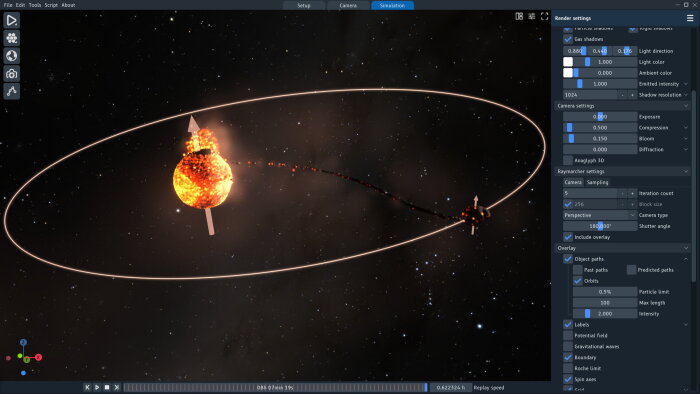
SpaceSim, a fascinating piece of software positioned at the intersection of scientific visualization and accessible education, offers users a window into the dramatic, complex processes that shape the cosmos. It is fundamentally a particle-based simulation and rendering application, meticulously engineered to tackle astrophysical phenomena. Its core methodology relies heavily on Smoothed Particle Hydrodynamics, or SPH, a numerical technique particularly well-suited for modeling systems where matter flows, deforms, and interacts gravitationally over vast scales of time and space. The breadth of phenomena SpaceSim allows users to explore is impressive, ranging from the immediate, violent consequences of high-energy collisions between celestial bodies, to the slow, majestic spiraling of matter within accretion disks encircling the darkest singularities in the universe, and further back to the colossal, chaotic ballet of gas clouds coalescing into the first galaxies in the nascent universe. This tool is not designed for casual gaming but for deep, experiential learning through computational modeling, bringing powerful scientific concepts down to the desktop level.
A critical distinction must be drawn immediately regarding the nature of SpaceSim: it is emphatically not a video game. While the word "Game" might appear in promotional contexts, the software explicitly lacks any traditional gaming elements such as progression systems, victory conditions, scoring, or sandbox mechanics intended for entertainment loops. Its primary directive is educational and demonstrative—the "de-mystification" of complex astrophysics simulations. Researchers typically run comparable simulations on massive supercomputing clusters, often taking weeks or months to complete high-fidelity runs involving billions of particles. SpaceSim brings this sophisticated level of modeling capability to a standard personal computer or laptop. It achieves this accessibility by employing simplified physics approximations and, crucially, by operating in a non-realtime environment. While simple simulations involving a few thousand particles might appear to run in real-time, high-fidelity explorations involving millions of particles are expected to demand significant computational time, potentially stretching into many hours, reflecting the underlying complexity of the physics being modeled. The user interface is crafted to be intuitive, deliberately abstracting away the underlying calculus, differential equations, and complex programming knowledge usually required to operate such systems, thereby lowering the barrier to entry for the scientifically curious public.
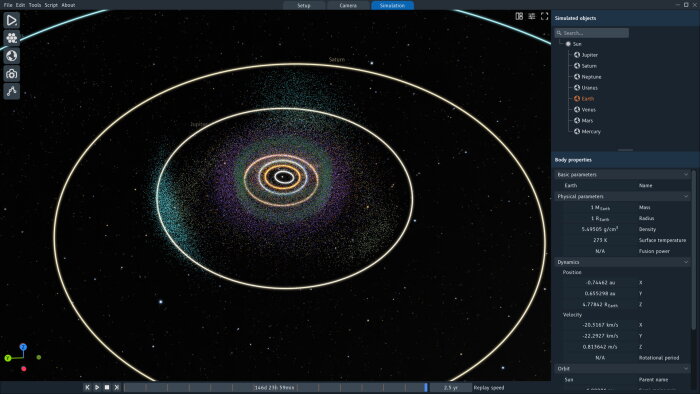
The scope of recreatable events within SpaceSim is remarkably broad, drawing inspiration directly from seminal work in astrophysics literature. Users possess the capability to set up scenarios mirroring famous historical or hypothetical cosmic events. For instance, one can model the catastrophic impact that theorists believe formed Earth's Moon, observing the ejection and subsequent re-accretion of material into a stable orbit. Another compelling application involves simulating the delicate gravitational interactions that lead to the formation of planetary ring systems, such as those famously displayed by Saturn, where countless small particles maintain complex, resonant orbits. More contemporary, real-world events are also within reach, such as modeling probe impacts like NASA's DART mission, allowing users to visualize the effects of kinetic energy transfer in deep space. Beyond grounded realism, SpaceSim encourages imaginative, yet physically constrained, exploration through "what-if" scenarios. Imagine calibrating a simulation to witness the direct collision between an object composed entirely of normal baryonic matter and an equally massive object made of anti-matter—a scenario that would release immense energy and test the limits of the simulation's particle interaction modeling.
At the foundational level, the simulation engine handles two primary forces that govern nearly all astrophysical interactions: fluid dynamics and gravitational attraction. Every object intended to deform or flow within the simulation—such as a gas cloud, a forming planet, or a star undergoing gravitational collapse—is represented by a collection of discrete particles. These particles interact locally, exchanging momentum and energy by solving discretized versions of the Navier-Stokes equations, which govern the behavior of viscous fluids. Simultaneously, every particle exerts and feels a gravitational force based on the presence and mass distribution of every other particle in the system. For efficiency in dealing with the long-range gravitational forces across potentially billions of particles, SpaceSim employs optimized techniques, specifically leveraging the well-regarded Barnes-Hut algorithm. Additionally, users have the option to define objects as strictly rigid bodies. This simplification bypasses the computationally intensive hydrodynamics calculations for that object, allowing it to maintain a fixed shape while participating fully in the gravitational and collision dynamics, which significantly speeds up simulations involving well-defined objects like moons or small asteroids in stable orbits.
The particle-based approach inherent to SPH is inherently powerful for modeling phenomena characterized by extreme density contrasts and fluid motion over many orders of magnitude. This makes SpaceSim exceptionally suited for visualizing processes like protoplanetary disk accretion, where dust and gas condense under gravity to form planets, or the large-scale structure formation where vast voids are punctuated by filamentary structures of merging and interacting galaxies. The use of individual particles to represent volume allows the simulation to naturally handle the merging, splitting, and chaotic evolution of gaseous structures without the geometric constraints imposed by grid-based methods common in other forms of computational fluid dynamics. The simulation therefore captures the intimate, local interactions crucial for studying phase transitions and gravitational instability across vast cosmic scales.
Object customization represents another significant area where SpaceSim empowers the user far beyond simple preset scenarios. The software provides a library of fundamental object templates directly mapped onto astronomical classifications: planets, stars, asteroids, diffuse gas clouds, accretion disks, and entire galaxy structures. Each template comes with a rich array of adjustable parameters. Users can precisely control their geometry (size, initial velocity vectors), material properties (density, viscosity, specific heat for fluid objects), and visual appearance (texture mapping and reflectivity). The visual fidelity of solid bodies can be enhanced significantly; for planets and rocky bodies, surface textures can be generated procedurally using mathematical noise functions to create realistic topographies, or they can be entirely customized by importing external image files or maps. Furthermore, for users seeking ultimate control or wishing to model entirely novel physical systems that fall outside the preset types, the software incorporates scripting capabilities using the Lua language. This powerful, lightweight scripting environment allows users to define entirely new object behaviors, interaction rules, or even complex multi-body systems governed by custom forces.
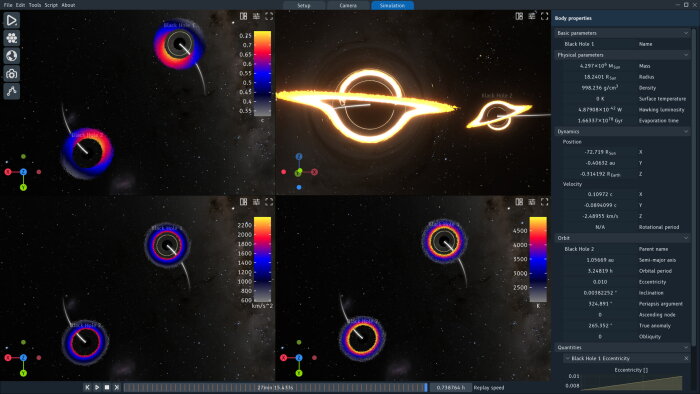
The treatment of singularities—specifically black and white holes—showcases SpaceSim's advanced rendering capabilities rather than just its simulation physics. While the underlying particle solver treats these objects as points of extreme gravity, the renderer incorporates the specialized visual effects that define these cosmic monsters. A key feature here is the incorporation of gravitational lensing, physically modeling how massive objects distort the fabric of spacetime. As light rays pass near a black hole, they are bent, leading to visually stunning and physically accurate renderings. This can manifest as warped, intensely bright accretion disks that appear dramatically twisted, or as multiple, duplicated images of background stars or galaxies appearing around the dark silhouette of the event horizon—the classic Einstein ring phenomenon being a prime example of this fidelity. This goes beyond simple particle visualization, integrating complex optics into the final rendered output.
To aid in understanding the complex physics unfolding within the particle cloud, SpaceSim incorporates multiple methods for data visualization that move beyond simple rendered aesthetics. Particle coloring is a powerful diagnostic tool, allowing the user to map the color of individual particles to instantaneous physical properties, such as their local velocity magnitude, internal pressure state, temperature, or even the material composition they represent. For orbital mechanics, the interface offers the ability to overlay crucial gravitational boundaries, such as the Roche Limit, which visually defines the distance within which a less massive body held only by its own gravity will be torn apart by the tidal forces of a larger central body. Furthermore, to conceptualize the invisible force of gravity, users can toggle the display of the gravitational potential field, visualizing the "gravity wells" surrounding massive objects as a continuous surface, thereby offering an intuitive graphical representation of the forces at play throughout the simulation volume.
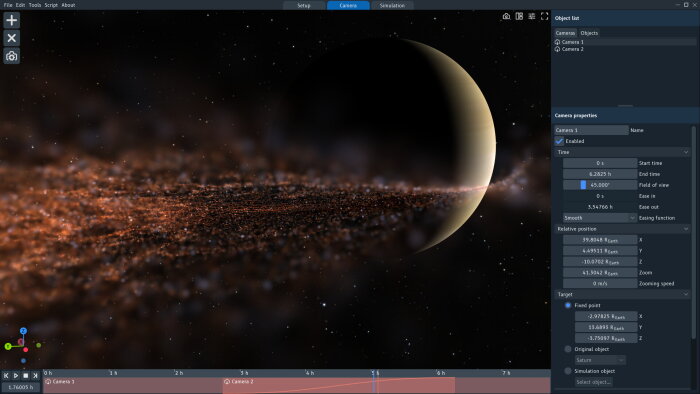
The architectural design of SpaceSim emphasizes computational flexibility and comprehensive output options. The simulation solver itself is designed to leverage modern hardware efficiently, supporting computation across both the general-purpose CPU cores and the highly parallel architecture of the GPU, allowing users to choose the pathway best suited for their specific hardware and simulation scale. Beyond gravitational optimization via Barnes-Hut, the software features a robust simulation history mechanism, allowing the user to save the entire state of a long-running simulation at any point and then instantly return to that snapshot for analysis or to initiate a divergent branch of the simulation path. For output, SpaceSim provides dual rendering pathways: a fast, real-time engine for interactive scene manipulation, and a high-fidelity Raymarcher designed for producing final, physically accurate images and videos. Capturing these results is straightforward, with built-in video recording utilizing the efficient H.264 codec, and professional-grade export options available for formats like Alembic and OpenVDB, ensuring compatibility with professional post-production and visual effects pipelines. Finally, the camera system is highly controllable, allowing for precise path definition, automatic tracking of specific objects, and the seamless transition between microscopic and cosmic scales.
The official release date for this powerful tool is set for December 15, 2025. Developed and published entirely by Pavel Ševeček, SpaceSim firmly occupies the Simulation genre, aiming to bridge advanced computational astrophysics with public engagement, making it a unique offering for educators, students, and space enthusiasts alike who wish to move beyond passive observation to active, physics-based exploration of the universe.
SpaceSim - Astrophysical Simulation Software Key Features
- Unleash the cosmos with Smoothed Particle Hydrodynamics (SPH) simulations!
- Witness colossal celestial collisions and the birth of galaxies!
- Explore non-realtime simulations of cosmic proportions—patience rewards discovery!
- Demystify astrophysics with accessible, desktop-powered science!
- Recreate iconic events like the Moon-forming impact or Saturn's rings!
- Design bizarre 'what-if' scenarios, like matter-antimatter planet smash-ups!
- Master gravity and fluid dynamics through detailed particle interaction!
- Sculpt and customize stars, planets, asteroids, and more with deep parameter controls!
- Forge your own celestial bodies using the Lua scripting engine!
- Gaze upon the mind-bending beauty of black hole gravitational lensing!
- Visualize the invisible: map particle properties, Roche limits, and gravity wells!
- Harness both CPU and GPU power for lightning-fast (or deeply complex) solving!
- Never lose a moment—store and replay your entire simulation history!
- Choose your viewing pleasure: blistering Real-time rendering or stunning Raymarcher precision!
- Craft cinematic captures with customizable camera paths and built-in H.264 video recording!
- Export your cosmic creations in professional formats like Alembic and OpenVDB!
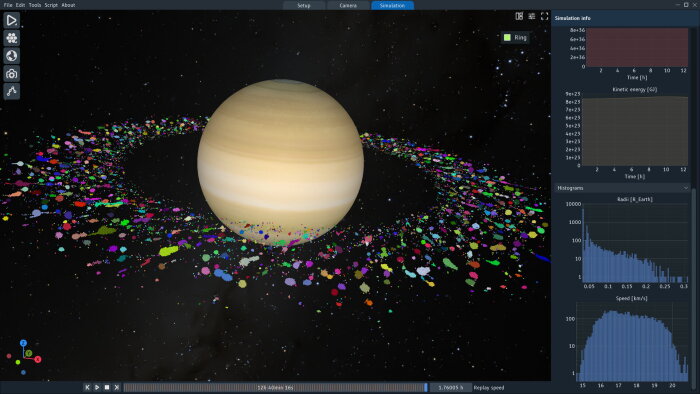
SpaceSim - Astrophysical Simulation Software Gameplay
Download Links for SpaceSim - Astrophysical Simulation Software
Download SpaceSim.Build.24847399
Mega
SpaceSim.Build.24847399.zip
1fichier
SpaceSim.Build.24847399.zip
Pixeldrain
SpaceSim.Build.24847399.zip
Mediafire
SpaceSim.Build.24847399.zip
Gofile
SpaceSim.Build.24847399.zip
Bowfile
SpaceSim.Build.24847399.zip
Buzzheavier
SpaceSim.Build.24847399.zip
Frdl
SpaceSim.Build.24847399.zip
Wdfiles
SpaceSim.Build.24847399.zip
Mixdrop
SpaceSim.Build.24847399.zip
Chomikuj
SpaceSim.Build.24847399.zip
Vikingfile
SpaceSim.Build.24847399.zip
Down mdiaload
SpaceSim.Build.24847399.zip
Hexload
SpaceSim.Build.24847399.zip
1cloudfile
SpaceSim.Build.24847399.zip
Usersdrive
SpaceSim.Build.24847399.zip
Megaup
SpaceSim.Build.24847399.zip
Clicknupload
SpaceSim.Build.24847399.zip
Dailyuploads
SpaceSim.Build.24847399.zip
Nitroflare
SpaceSim.Build.24847399.zip
Multiup
SpaceSim.Build.24847399.zip
Trbt
SpaceSim.Build.24847399.zip
Hitfile
SpaceSim.Build.24847399.zip
System Requirements for SpaceSim - Astrophysical Simulation Software
The SpaceSim astrophysical simulation software has distinct minimum and recommended system requirements. To run the application at a minimum, users will need an operating system of Windows 10, a processor capable of supporting SSE 4.1 instructions, 4 GB of RAM, a graphics card supporting OpenGL 4.6, and 500 MB of free storage space. For an optimal experience, the recommended specifications suggest using Windows 10 or 11, maintaining a CPU that supports SSE 4.1 (with the note that simulation speed is heavily dependent on CPU capabilities, favoring more cores), increasing the required memory to 16 GB of RAM, utilizing a GPU that supports OpenGL 4.6 and includes at least 4 GB of dedicated VRAM, and ensuring at least 10 GB of storage space is available.
Minimum:- OS: Windows 10
- Processor: CPU supporting SSE 4.1
- Memory: 4 GB RAM
- Graphics: GPU supporting OpenGL 4.6
- Storage: 500 MB available space
- OS: Windows 10 or 11
- Processor: CPU supporting SSE 4.1
- Memory: 16 GB RAM
- Graphics: GPU supporting OpenGL 4.6 with 4 GB VRAM
- Storage: 10 GB available space
- Additional Notes: CPU determines how fast the simulation can run. Generally, more cores = more speed.
How to Download SpaceSim - Astrophysical Simulation Software PC Game
1. Extract Release
2. Launch The Game
3. Play!