
Uptime: A Cloud Provider Sim Game Details
Title: Uptime: A Cloud Provider Sim
Genre: Indie, Simulation
Developer: RubyRack Games
Publisher: RubyRack Games
Release Date: 17 July 2026
Store: Steam
Game Releasers: P2P
About Uptime: A Cloud Provider Sim Game
Build and maintain your own infrastructure from a garage to a hyperscaler in *Uptime*, a hardcore first-person simulation where every cable, switch, and BGP route is a real, working part of the engine.
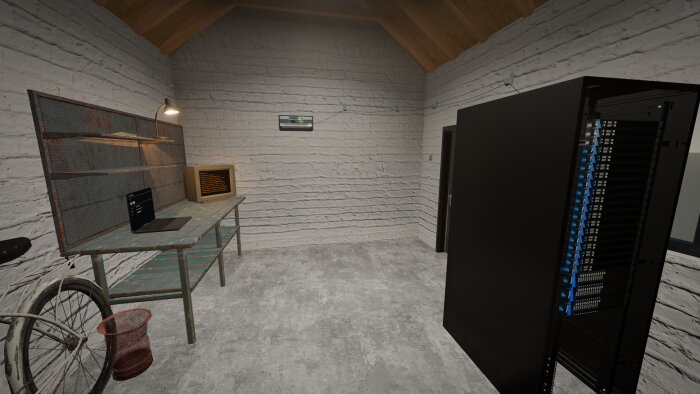
In the vast, often sterile world of digital infrastructure management, the bridge between abstract coding and physical manifestation is frequently crossed only in the minds of the engineers responsible for keeping the lights on. Uptime: A Cloud Provider Sim Game invites players to step out of the comfort zone of spreadsheets and monitoring dashboards, placing them squarely in the shoes of a hands-on infrastructure architect. This is not merely a game about managing a digital cloud; it is a visceral, tactile exploration of what it means to build, maintain, and defend the physical backbone of the modern internet. By starting from the humble beginnings of a single rack in a garage and clawing your way up toward the dizzying heights of a hyperscaler, you are tasked with understanding that the cloud is not some ethereal, weightless concept—it is a collection of heavy metal, miles of cabling, and precarious power budgets that demand constant attention.
The core gameplay philosophy of this simulator is built on the premise that you do not manage a data center from a remote desk; you manage it by walking the floor. Every piece of hardware, from high-density server blades to complex network switches, is an object that must be physically handled. You will spend your early hours manually carrying servers from a loading bay to a rack, carefully seating them into their chassis, and feeling the weight of the task. Your primary tool is not just an interface, but your own virtual presence, allowing you to manipulate the environment in a deeply immersive way. When a connection is required, you are the one pulling the cable from the spool, snaking it across the floor or tucking it neatly into a tray, and verifying that the port blinks to life. This physical agency turns the familiar frustration of cable management into a rewarding, mechanical loop that honors the craft of professional systems administration.
Underneath the tactile experience lies a rigorous, deterministic engine that refuses to compromise on reality. This is not a game where status bars are merely decorative or where complex problems can be simplified into a binary "on" or "off." Every cable you run is a functional pathway, every port you activate contributes to a real-time stream of data, and every switch acts as a node in a complex, breathing network fabric. If you fail to account for the dangers of a spanning tree loop, the simulation will not hesitate to punish you; a broadcast storm will effectively drown your infrastructure in traffic, grinding your services to a halt. The game demands that you understand the underlying principles of BGP, link aggregation, and fault domains, treating these concepts not as flavor text for enthusiasts but as critical mechanics that dictate the success or failure of your entire enterprise.
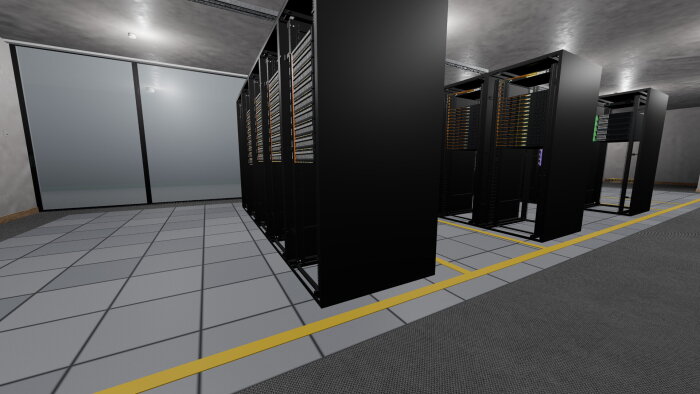
Your survival as a provider depends entirely on the trust you cultivate with your tenants. These customers are not faceless data points; they are entities with their own businesses, deadlines, and technical expectations. When a company chooses to build their product on your hardware, they are entering into a pact that relies on your competence. Reputation acts as the currency of the game—a fragile asset that is accumulated slowly through uptime and reliability but can be vaporized in a single, poorly managed incident. If you over-provision your resources or fail to anticipate the surge of a growing tenant, the fallout is immediate and personal. You will find yourself reading through communication channels that mirror the high-stakes, high-pressure environments of professional operations teams, where an outage at two in the morning is not merely a game mechanic, but a genuine crisis that forces you to choose between sleeping through an SLA breach or frantically troubleshooting a failing node in the dark.
Operating as a cloud provider requires you to manage the entire stack, which includes keeping the control planes of your specific services alive and functional. It is not enough to simply provide the metal; you must ensure that your virtual machines, object storage, and managed databases have the internal support they need to report their status to you. If a technical error or a poor network configuration partitions your control plane from the host agents, your services will effectively go blind, leading to cascading failures that are as educational as they are stressful. Balancing the needs of your customers' workloads against the overhead of your own management agents requires a delicate touch and a deep understanding of resource competition. It is a constant game of trade-offs where the network begins to "grow teeth," making every decision feel consequential.
A defining feature of Uptime is its dedication to accessibility without sacrificing technical rigor. Whether you are a seasoned network engineer who speaks the language of MTBF and redundancy, or a newcomer who has never touched a rack, the game offers a way forward through its unique jargon toggle. You can choose to interact with the world through the lens of professional engineering terminology or plain-language descriptors, effectively bridging the gap between those who live in the industry and those who are just beginning to learn the ropes. This design choice ensures that the simulation is not only a playground for pros but also a pedagogical tool that teaches the reality of infrastructure through play, turning dry technical definitions into practical lessons that you learn by doing rather than by reading a manual.
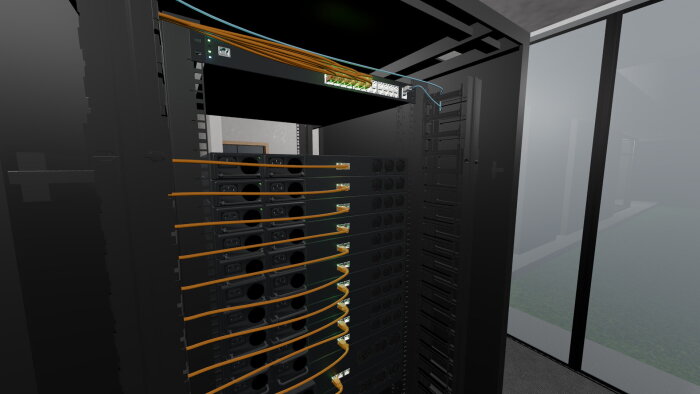
The difficulty scaling is designed to keep the experience fresh and challenging, regardless of how much you have mastered the underlying systems. Across Easy, Standard, and Hard modes, the simulation adjusts its parameters to provide a tailored experience that never feels arbitrary. Even in the most punitive settings, the behavior of the world remains consistent because it is governed by the same deterministic logic. If you lose a rack in the middle of a high-pressure scenario, it is because you introduced a single point of failure that the simulation recognized and exploited. This fairness is at the heart of the game’s design; no incident is scripted to happen just for the sake of drama. Every disaster is emergent, arising naturally from the limitations of the hardware you have chosen and the configuration you have applied, making every recovery effort feel earned.
Building your empire from a single, dusty garage to a sprawling facility that services the needs of multiple corporations is a narrative arc that feels genuinely earned. The campaign provides structure, guiding you through the evolution of your site as you upgrade your power distribution, expand your networking capabilities, and learn to manage the logistics of a growing data center. Beyond the campaign, the sandbox mode offers a wide-open canvas where you can experiment with architectural patterns or stress-test your network without the pressure of external deadlines. Because the scenarios are built on human-readable files, the barrier for the community to contribute their own unique challenges, scenarios, and constraints is remarkably low, ensuring that the life of the game extends far beyond the initial release.
As you look at the LEDs on your switches and the status lights on your server racks, you are reminded that you are not just playing a simulation; you are observing a live model of the complexity that sustains the digital world. The decision to use a Rust-based engine ensures that the physics of the network, the power draw, and the capacity of the hardware are calculated with mathematical precision. There are no hidden multipliers or artificial buffs here; if your uplink is saturated, it is because the math dictated that the data could not pass through. This commitment to honesty creates a unique bond between the game and the player, fostering an environment where curiosity is rewarded and technical blunders are turned into wisdom. In the end, this is a simulator that respects the intelligence of its audience, inviting them to sit in the chair of an engineer and discover the beauty of a system that works, precisely because they made it work.
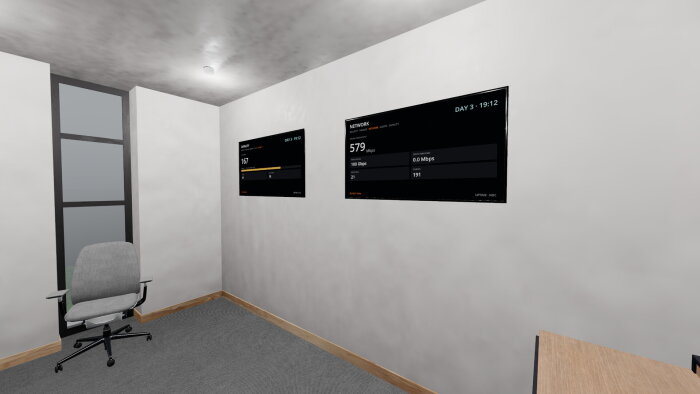
Uptime: A Cloud Provider Sim Key Features
- * Build your digital empire from a humble garage rack all the way to a massive hyperscale datacenter!
- * Experience complete hands-on control as you physically carry servers, seat hardware, and wire up every single cable yourself.
- * Master a deep, deterministic simulation where BGP, spanning tree, and power budgets aren't just flavor text—they are the heart of your infrastructure.
- * Face the pressure of real customer demands where every signup is a calculated risk and a single outage can destroy your reputation.
- * Feel the thrill of a responsive world where your network choices and capacity management directly dictate if your services stay online.
- * Bridge the gap between novice and pro with a toggleable jargon mode that lets you learn the real terminology of the cloud as you play.
- * Deploy complex services like Kubernetes, object storage, and managed databases, then manage the control planes that keep them alive.
- * Solve emergent incidents that feel exactly like real-world ops, challenging you to diagnose failures in hardware, routing, and configurations.
- * Dive into a fully moddable sandbox where you can create, share, and play custom scenarios that push your engineering skills to the limit.
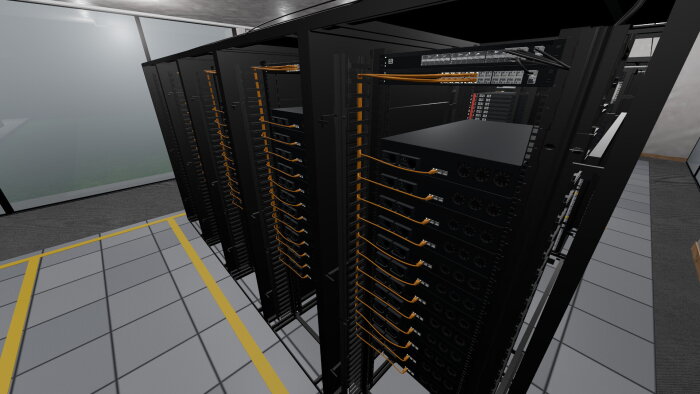
Uptime: A Cloud Provider Sim Gameplay
Download Links for Uptime: A Cloud Provider Sim
Download Uptime.A.Cloud.Provider.Sim.Build.25546166
Mega
Uptime.A.Cloud.Provider.Sim.Build.25546166.zip
1fichier
Uptime.A.Cloud.Provider.Sim.Build.25546166.zip
Pixeldrain
Uptime.A.Cloud.Provider.Sim.Build.25546166.zip
Mediafire
Uptime.A.Cloud.Provider.Sim.Build.25546166.zip
Gofile
Uptime.A.Cloud.Provider.Sim.Build.25546166.zip
Bowfile
Uptime.A.Cloud.Provider.Sim.Build.25546166.zip
Buzzheavier
Uptime.A.Cloud.Provider.Sim.Build.25546166.zip
Frdl
Uptime.A.Cloud.Provider.Sim.Build.25546166.zip
Wdfiles
Uptime.A.Cloud.Provider.Sim.Build.25546166.zip
Mixdrop
Uptime.A.Cloud.Provider.Sim.Build.25546166.zip
Chomikuj
Uptime.A.Cloud.Provider.Sim.Build.25546166.zip
Vikingfile
Uptime.A.Cloud.Provider.Sim.Build.25546166.zip
Down mdiaload
Uptime.A.Cloud.Provider.Sim.Build.25546166.zip
Hexload
Uptime.A.Cloud.Provider.Sim.Build.25546166.zip
1cloudfile
Uptime.A.Cloud.Provider.Sim.Build.25546166.zip
Usersdrive
Uptime.A.Cloud.Provider.Sim.Build.25546166.zip
Megaup
Uptime.A.Cloud.Provider.Sim.Build.25546166.zip
Clicknupload
Uptime.A.Cloud.Provider.Sim.Build.25546166.zip
Dailyuploads
Uptime.A.Cloud.Provider.Sim.Build.25546166.zip
Rapidgator
Uptime.A.Cloud.Provider.Sim.Build.25546166.zip
Nitroflare
Uptime.A.Cloud.Provider.Sim.Build.25546166.zip
Multiup
Uptime.A.Cloud.Provider.Sim.Build.25546166.zip
System Requirements for Uptime: A Cloud Provider Sim
To run *Uptime: A Cloud Provider Sim*, your PC must be running a 64-bit version of Windows 10 (build 1909 or higher) at a minimum, though Windows 11 is recommended for optimal performance. Hardware requirements start with a quad-core processor like the Intel Core i5-8400 or Ryzen 3 3100 and 8 GB of RAM, stepping up to a 6-core Intel 10th-gen or Ryzen 5 processor and 16 GB of RAM for the recommended experience. A crucial requirement for the game is a GPU capable of Direct3D 12 or Vulkan 1.2; entry-level play requires at least 4 GB of VRAM such as the GTX 1650, RX 570, or Arc A380, while the recommended settings suggest 6–8 GB of VRAM via an RTX 2060, RTX 3060, or RX 6600. Finally, ensure you have at least 3 GB to 5 GB of available storage space, with an SSD strongly advised to ensure the best performance during gameplay.
Minimum:- OS: Windows 10 64-bit (version 1909 or newer)
- Processor: Quad-core - Intel Core i5-8400 / AMD Ryzen 3 3100
- Memory: 8 GB RAM
- Graphics: 4 GB VRAM, Direct3D 12 / Vulkan 1.2 - NVIDIA GTX 1650 / AMD RX 570 / Intel Arc A380
- DirectX: Version 12
- Storage: 3 GB available space
- Additional Notes: Requires a GPU with Direct3D 12 or Vulkan 1.2 support
- OS: Windows 11 64-bit
- Processor: 6-core - Intel Core i5-11400 / AMD Ryzen 5 5600
- Memory: 16 GB RAM
- Graphics: 6-8 GB VRAM - NVIDIA RTX 2060 / RTX 3060 / AMD RX 6600
- DirectX: Version 12
- Storage: 5 GB available space
How to Download Uptime: A Cloud Provider Sim PC Game
1. Extract Release
2. Launch The Game
3. Play!