Who am I: Remedy Game Details
Title: Who am I: Remedy
Genre: Adventure, Indie
Developer: The Tree Gameworks
Publisher: The Tree Gameworks
Release Date: 26 March 2026
Store: Steam
Game Releasers: P2P
About Who am I: Remedy Game
**Trapped in a shifting house and a repeating loop, can you uncover the truth before the watching Shadow claims you in this found footage psychological horror?**
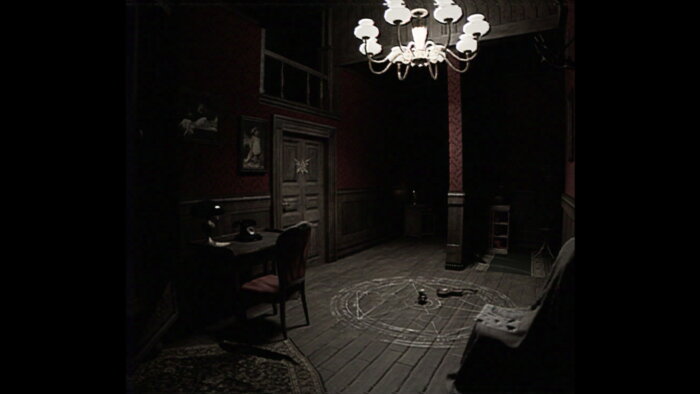
You are the protagonist of **Who Am I: Remedy**, a deeply unsettling, found footage psychological horror experience that plunges the player directly into the terrifying confines of a repeating time loop. Your existence, as far as you can ascertain upon waking, is entirely stripped away; you possess no name, no history, only the immediate, disorienting reality of an empty, labyrinthine house. This environment immediately establishes a predatory atmosphere, suggesting that whatever awareness resides within these walls is not benevolent but keenly observant of your every move. You are, by the narrative's definition, an "unsub," a term usually reserved for an unknown subject of investigation, yet here, it seems to describe your very state of being—a nameless entity trapped within a cyclical nightmare, forcing you to confront not just external threats but the profound mystery of your own indeterminate identity. The central conflict is therefore dual-layered: survival within a hostile, shifting architecture, and the desperate attempt to reconstruct the narrative thread that binds you to this place, hoping that understanding the past will grant you passage to an unknown future.
The core mechanic driving the immersion in **Who Am I: Remedy** is the deliberate, almost intrusive use of the found footage aesthetic. This is not merely a visual filter but a fundamental layer of interaction and perception. The world is perpetually viewed through the grainy, imperfect lens of an old camera, complete with all the attendant visual distortions: the characteristic noise and jitter of aging tape, sudden focus shifts that obscure crucial details, and the omnipresent sense of degradation that mirrors the protagonist's fracturing reality. This presentation choice immediately distances the player from the standard, high-definition clarity of modern gaming, instead fostering a visceral, subjective experience akin to viewing authentic, highly distressing recovered evidence. Furthermore, the environment itself seems to participate in this deception. Corridors are unreliable paths, doors assert their own volition regarding access, and the very layout of the house demonstrates a conscious, adaptive intelligence. This shifting geography ensures that rote memorization is useless; the house actively resists being mapped or understood, forcing the player into a constant state of vigilance as the familiar suddenly becomes alien.
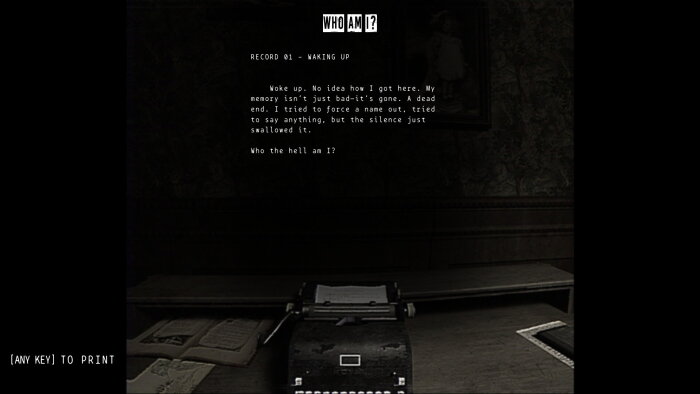
A crucial element bridging the gap between fragmented experience and coherent understanding is the meticulous, physical act of investigation. The game demands that you engage with the environment not just by looking, but by actively recording and documenting. Central to this process is the antique typewriter, serving as the main interface for constructing your narrative reports. Each artifact discovered, each unsettling encounter witnessed through the camera lens, must be manually transcribed. This deliberate, slow-paced interaction—the clacking of keys, the physical act of drafting sentences—forces a contemplative distance, even amidst mounting terror. You are not simply playing a character; you are functioning as the documentarian of your own descent. These typed reports become the tangible evidence of your progress, piecing together the puzzle pieces of the overarching mystery. This reliance on tactile, analog interaction is a deliberate counterpoint to the digital nightmare unfolding around you, grounding the psychological horror in relatable, historical methods of investigation.

The narrative scaffolding of **Who Am I: Remedy** relies heavily on the collection of these scattered artifacts. These are not mere collectibles; they are memory fragments, echoes of past events, or perhaps even temporal anchors within the loop. Each item unearthed within the depths of the house provides a small informational kernel, adding depth to the unfolding trauma and slowly illuminating the circumstances that led to your current predicament. As you gather more of these tangible links to the house's history—perhaps notes, personal belongings, or remnants of previous investigations—the abstract feeling of dread begins to coalesce into a comprehensible, albeit frightening, storyline. The act of collecting is synonymous with the act of remembering, and escaping the loop is inextricably linked to achieving a comprehensive understanding of the sequence of events that initiated it. The house, therefore, functions as both prison and archive, its very structure dedicated to hiding the truth just out of reach.
Adding another layer of challenging engagement are the various environmental and logical puzzles integrated throughout the exploration. These riddles are rarely simple juxtapositions of objects; they are often woven into the very fabric of the house's temporal anomalies or its shifting architecture. Succeeding at these puzzles requires keen observation, the correct application of the knowledge gleaned from your collected reports, and often, a willingness to embrace the illogical nature of the looping environment. Since the landscape adapts to your movements, solving a puzzle might involve triggering a sequence that temporarily stabilizes a segment of the house, opening a path that was previously sealed by a non-Euclidean design. The difficulty stems from the fact that the rules governing the environment are fluid, demanding flexibility in thinking and careful consideration of past inconsistencies that might now serve as clues to the present challenge.
Underpinning every moment of exploration and documentation is the constant, chilling awareness that you are being observed. The game emphasizes that you are definitively *not alone*. This presence, often referred to as "the Shadow," is the most potent source of the psychological terror. It manifests less through direct jump scares—though those may occur—and more through a pervasive sense of being stalked, scrutinized, and mentally prodded. The constant threat of the Shadow ensures that moments of quiet contemplation over the typewriter are laced with anxiety, as the player must remain acutely aware of auditory cues and subtle visual shifts that signal its proximity. This antagonist is deeply integrated into the found footage style, perhaps only glimpsed in brief flickers on the camera feed or hinted at through disturbing interference patterns, making its reality both undeniable and frustratingly ambiguous.

The developer’s stated ambition for **Who Am I: Remedy** is to transcend simple visual frights, aiming instead for a deep, existential discomfort rooted in the player’s immersion within the setting. The goal is to manufacture a persistent feeling of presence—the sensation of truly inhabiting this forgotten, hostile structure. This is achieved through meticulous attention to the atmospheric triggers: the carefully modulated original soundtrack, which likely oscillates between unsettling silence and discordant musical cues, and the heavy reliance on environmental feedback. The pressure exerted on the player is continuous, designed to erode confidence not just in their ability to progress, but in their own perception of reality within the game world. This psychological pressure cooker environment is the true horror engine, forcing the player to question every sound, every shadow, and every apparent truth uncovered through the investigation.
Ultimately, **Who Am I: Remedy** appears to be a carefully constructed exercise in breaking down and rebuilding identity within a hostile, recursive space. As the release date of March 26, 2026, approaches, the anticipation centers on whether The Tree Gameworks can successfully weave together the analog mechanics—the typing, the artifacts, the VHS grain—with the metaphysical dread of the time loop and the lurking Shadow. The promise is a horror title that demands patience, documentation, and a willingness to embrace confusion as a necessary precursor to revelation. The player must willingly surrender their sense of self to the unsub they inhabit, hoping that by documenting the nightmare for an unseen publisher, they might finally write an ending where they are able to wake up and truly know who they are, free from the house’s inescapable, repeating embrace.
Who am I: Remedy Key Features
- Trapped in an ever-shifting house within a terrifying time loop!
- Experience pure psychological horror through an immersive VHS found footage style!
- Manually type your investigation reports on an authentic typewriter!
- Unravel a deep mystery by collecting artifacts that shape the story!
- Face unique puzzles designed to challenge your perception!
- Beware, the ever-present Shadow watches your every move!
- Feel the atmosphere with an original, chilling soundtrack!
Who am I: Remedy Gameplay
Download Links for Who am I: Remedy
Download Who.am.I.Remedy-GoldBerg
Mega
Who.am.I.Remedy-GoldBerg.rar
1fichier
Who.am.I.Remedy-GoldBerg.rar
Pixeldrain
Who.am.I.Remedy-GoldBerg.rar
Mediafire
Who.am.I.Remedy-GoldBerg.rar
Gofile
Who.am.I.Remedy-GoldBerg.rar
Rootz
Who.am.I.Remedy-GoldBerg.rar
Ranoz
Who.am.I.Remedy-GoldBerg.rar
Datanodes
Who.am.I.Remedy-GoldBerg.rar
Drop
Who.am.I.Remedy-GoldBerg.rar
Bowfile
Who.am.I.Remedy-GoldBerg.rar
Transfert free
Who.am.I.Remedy-GoldBerg.rar
Swisstransfer
Who.am.I.Remedy-GoldBerg.rar
Frdl
Who.am.I.Remedy-GoldBerg.rar
Fileditchfiles
Who.am.I.Remedy-GoldBerg.rar
Uploadnow
Who.am.I.Remedy-GoldBerg.rar
Wdfiles
Who.am.I.Remedy-GoldBerg.rar
Mixdrop
Who.am.I.Remedy-GoldBerg.rar
Chomikuj
Who.am.I.Remedy-GoldBerg.rar
Vikingfile
Who.am.I.Remedy-GoldBerg.rar
Dayuploads
Who.am.I.Remedy-GoldBerg.rar
Down mdiaload
Who.am.I.Remedy-GoldBerg.rar
Hexload
Who.am.I.Remedy-GoldBerg.rar
1cloudfile
Who.am.I.Remedy-GoldBerg.rar
Usersdrive
Who.am.I.Remedy-GoldBerg.rar
Megaup
Who.am.I.Remedy-GoldBerg.rar
Clicknupload
Who.am.I.Remedy-GoldBerg.rar
Dailyuploads
Who.am.I.Remedy-GoldBerg.rar
Rapidgator
Who.am.I.Remedy-GoldBerg.rar
Nitroflare
Who.am.I.Remedy-GoldBerg.rar
Multiup
Who.am.I.Remedy-GoldBerg.rar
System Requirements for Who am I: Remedy
To run the Remedy system, your computer will require a 64-bit version of Windows 10 as the operating system, paired with at least an Intel Core i5-8400 or an AMD Ryzen 5 2600 processor. You will need a minimum of 8 GB of RAM installed, and the graphics processing unit must be an NVIDIA GTX 1070 or equivalent, supporting DirectX Version 12. Finally, ensure you have at least 3 GB of free space available on your storage drive and a DirectX-compatible sound card for the required audio output.
Minimum:- OS: Windows 10 64-bit
- Processor: Intel Core i5-8400 / AMD Ryzen 5 2600
- Memory: 8 GB RAM
- Graphics: NVIDIA GTX 1070
- DirectX: Version 12
- Storage: 3 GB available space
- Sound Card: DirectX Compatible Sound Card
How to Download Who am I: Remedy PC Game
1. Extract Release
2. Launch The Game
3. Play!